
Geology
small headline
Big Headline here
Mining the future in a safe, certain and sustainable way
Boulby boasts a remarkable history of responsible operation as the UK’s deepest mine, and we are continuously developing strategies to ensure effective stewardship while securing the project’s longevity for decades ahead. Our exploration geologists play a crucial role in pinpointing mining locations, safeguarding our future. By repositioning Boulby Mine, we align with our company vision: “We are committed to creating responsible solutions to humanity’s sustainability challenges in the global food, agriculture, and industrial products markets.”
The extensive tunnels and roadways of Boulby Mine extend deep beneath the North Sea, with their precise direction managed by a skilled team of Geologists. The geology department is divided into two branches: exploration geology, which focuses on studying rock patterns and formations to locate essential minerals beneath the surface. They then relay this information to the second branch, production geology. This essential knowledge drives drilling into new areas, allowing Europe’s second deepest mine to delve even deeper and explore new mining frontiers.
Exploration geologists are tasked with mapping the minerals—both valuable and otherwise—located underground at Boulby Mine. They assess not only the locations of these minerals but also their thickness and accessibility with our industrial machinery. This information enables production geologists to devise effective strategies for mineral extraction.
While exploration geologists gather critical data, production geologists formulate actionable plans to guide the underground mining process. The core purpose of Boulby is to extract mineral fertilisers from the earth, which are then utilised globally to support the growing global population’s food needs.
These invaluable fertiliser minerals are vital to addressing humanity’s increasing demand for sufficient food, and our dedicated team of geologists is committed to working tirelessly to meet this challenge.
Drilling
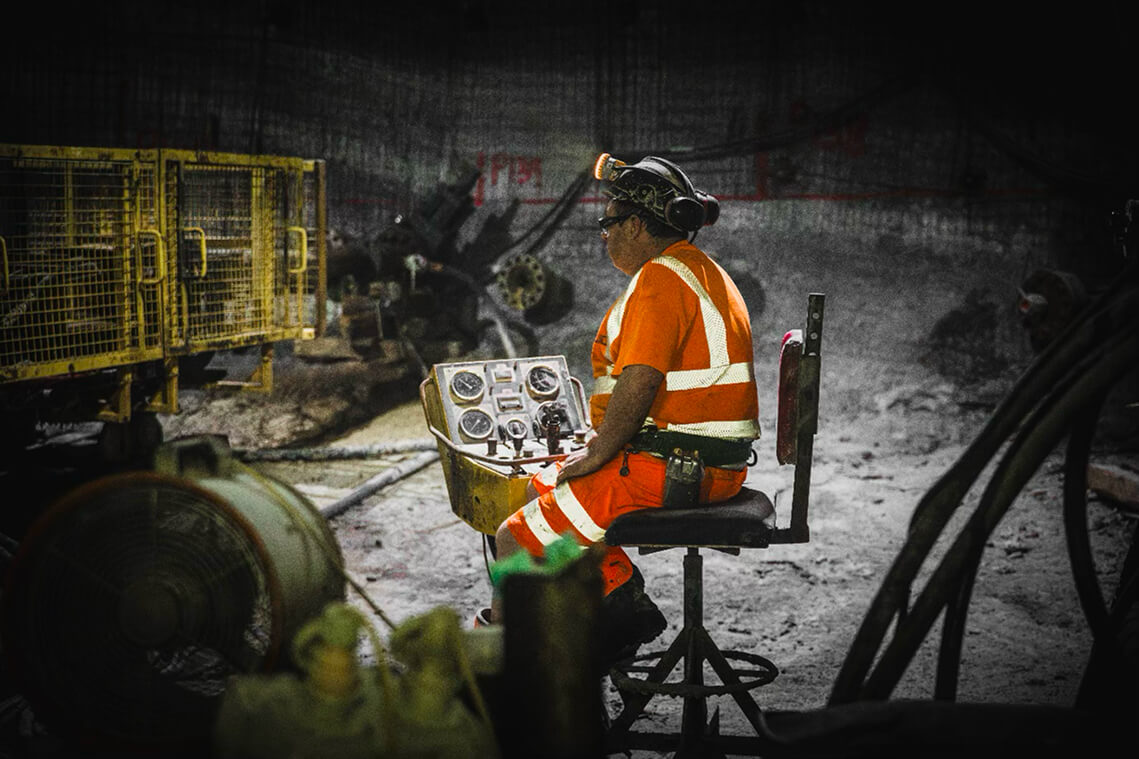
Exploration geologists collaborate closely with the exploration drilling team to discover new mineral resources. Drilling retrieves long rock cores, which helps create an understanding of the surrounding geology. Geologists analyse these drill cores and sample mineral-rich areas to assess the quantity and quality of ore, its thickness, and how far it extends laterally. They also identify potential challenges that production geologists may encounter when mining, such as exceptionally hard or soft minerals, which could impact machinery performance or roadway stability.
The rock samples retrieved from exploration drilling have remained untouched by sunlight for 260 million years. The potash and polyhalite ore was formed during the Permian period, long before dinosaurs roamed the Earth. This remarkable process essentially allows us to traverse backward through geological history.
Various computer software tools assist exploration geologists in creating geological maps and models of the mineral deposits located underground. The extensive data collected from drilling is entered into this software and organised into a ‘data cube,’ which gradually becomes comprehensive enough to be shared with the production geology team.
This crucial information is then passed on to production geologists, who use it to direct the roadways toward the most promising mining areas. If the geology in the mined area deviates from expectations, the model is adjusted, and production geologists create a new mining strategy.
At ICL UK, we adhere to strict certification and criteria that our products must meet before they are sold. Collecting and analysing samples from our underground mining sites is essential, as it enables us to continuously monitor the quality of the minerals we extract. This process, known as grade control, allows us to make necessary adjustments if our standards are not met.
Recent Discoveries
Our exploration geologists have identified and continue to uncover vast reserves of polyhalite, a new multi-nutrient mineral that has captured our focus. The extraction of our polyhalite is safe, and it exists in ample quantities to warrant investment in its efficient mining. Currently, we estimate around 1 billion tonnes of polyhalite resources, some of which are already being extracted, establishing ICL UK as the exclusive global producer of this mineral.
In 2017, we achieved a significant milestone by mining 1 million tonnes of polyhalite at ICL Boulby, and we have ambitious plans ahead. As the only global miners of polyhalite, we leverage our expertise to aim for an annual extraction of 1 million tonnes.